Wall-Mounted vs Recessed Electric Fireplace: Which to Choose
One hangs on the wall in an afternoon, the other sits flush inside it and needs framing. Here's how wall-mounted and recessed electric fireplaces compare on depth, labor, cost, heat and life under a TV.
 The Fireplace Co. team
Updated November 12, 2026
7 min read

In this guide 10 sections
The heat and the flame are usually the same either way. The real differences are how much carpentry you’re signing up for and how the finished wall looks.
Wall-mounted vs recessed at a glance
| Wall-mounted | Recessed | |
|---|---|---|
| Where it sits | On the wall surface, hung from a bracket | Inside a framed opening, front flush or nearly flush with the wall |
| Wall work | Find studs, drill, hang | Cut drywall, frame the opening, often build out the wall, patch and finish |
| Typical time | An hour or two | A weekend, plus drywall finishing time |
| Skills | Basic DIY | Framing and drywall, or a carpenter |
| Look | A slim panel standing off the wall | Built-in, like it came with the house |
| Heat | Same heater | Same heater, as long as vents stay clear |
| Power | Nearby outlet, cord covered on the wall | Outlet inside the framing, cord hidden |
| Moving it later | Unscrew it and patch a few holes | Means reworking the wall |
| Good for renters | Yes | Rarely |
What wall-mounted and recessed actually mean
A wall-mounted electric fireplace is a slim box that hangs on the wall like a TV. Its whole depth sticks out into the room. Our wall-mounted fireplace with 7 flame colors, for example, lists an overall depth of 4.5 inches and is made to hang only.
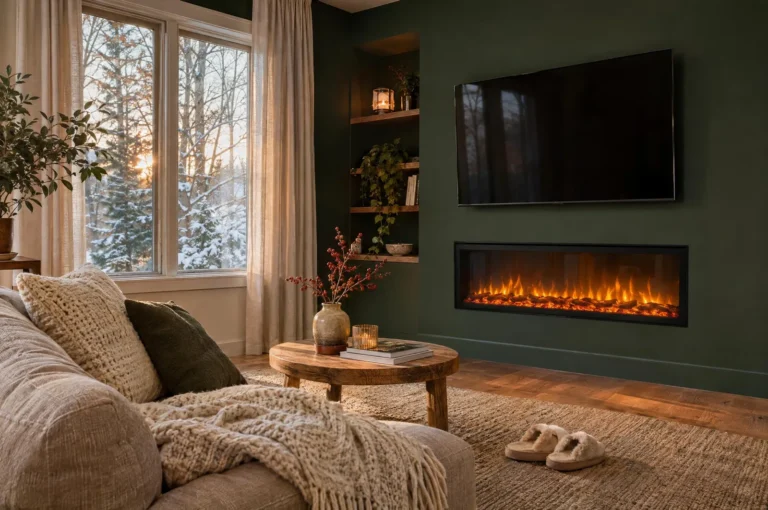
A recessed (or in-wall) electric fireplace slides into an opening framed in the wall, so the glass sits flush or close to flush with the finished surface. A built-in unit is a step further: it’s finished right into the wall and usually can’t come out without opening the wall again.
Many units do both. Our 42-inch recessed fireplace comes in 36, 42, 50 and 60-inch sizes and can be wall-mounted, recessed or set on legs on a tabletop. That’s handy if you want to hang it now and recess it when you remodel.
Framing and depth: what a recessed install needs
Depth decides most recessed projects. Standard walls are framed with 2×4 or 2×6 studs, which leave a cavity of about 3.5 inches or about 5.5 inches. Check the listed depth of the fireplace you want against that. If the unit is deeper than your stud cavity, you have two choices: a thicker wall or a build-out.
A build-out (also called a bump-out or false wall) is a new section of framing in front of the existing wall. It gives you the depth the fireplace needs and room to run TV wiring. It’s also how most media walls get built.
Before you cut anything:
- Check what’s in the wall. Use a stud finder, look for outlets and switches nearby, and check the floor below or the attic above for pipes, ducts and wiring.
- Know if it’s load-bearing. Cutting a stud in a load-bearing wall needs a properly sized header. If you’re not sure, ask a contractor before you cut.
- Avoid exterior walls if you can. They hold insulation and a vapor barrier. A build-out on the inside of an exterior wall keeps the insulation intact.
- Plan the power. The outlet goes inside the framed opening, where the manual says. Electrical codes generally don’t allow a plug-in appliance cord to run inside a wall, so have an electrician add the outlet.
- Follow the opening size in the manual. Frame to the maker’s rough opening, not to the outside dimensions of the box.
What a wall-mounted install needs
A lot less. Find at least two studs, screw the bracket into them, hang the unit and plug it in. Keep it close to an outlet so the cord run is short, and cover the cord with a paintable cord cover. Plug straight into the wall, never into an extension cord or power strip. If you don’t want any visible cord, have an electrician put an outlet directly behind the unit.
Cost and labor
Our wall-mounted and recessed units run roughly $200 to $450, depending on size and features, and shipping is free to the lower 48 states. The fireplace costs about the same either way. The difference is everything around it.
A wall-mounted install costs you a few screws and maybe a cord cover. A recessed install adds lumber, drywall, tape and mud, paint, any trim or tile you put around it, and often an electrician for the outlet. If you hire a carpenter for the framing and finishing, labor can easily cost more than the fireplace. Get a quote before you decide.
Which looks better?
Recessed, if you want it to look like it belongs to the house. A flush fireplace with a clean frame around it reads as architecture, especially under a TV or in a tiled or wood-paneled feature wall.
Wall-mounted looks intentional too, especially in modern rooms. A slim panel floating at sofa height works well in bedrooms, apartments and offices. A curved-front model, like our 48-inch curved wall-mounted unit, gives a hanging fireplace more presence.
Does recessing change the heat?
Not if you install it right. Most of our wall and recessed units carry a 1,400 W heater rated for supplemental heat up to 400 sq ft. The 7-color wall model switches between 725 W and 1,450 W. At about 17¢ per kWh, 1,400 W costs about 24¢ an hour on high.
What can hurt the heat is blocking air. On our 36, 42 and 60-inch recessed models, the air outlet is in the middle and the intakes are at the top left and right. Keep trim, tile and stone clear of those openings, and never pack insulation around the box unless the manual says to.
Putting a TV above it
Both styles work under a TV, and that’s one of the most common reasons people buy one. A few things to plan:
- Follow the clearance in the manual between the top of the fireplace and the bottom of the TV.
- Know where the heat goes. If warm air leaves from the top, a mantel shelf between the fireplace and the TV helps push it into the room instead of up the screen.
- Watch the TV height. A fireplace underneath pushes the TV up. A shorter fireplace keeps the screen closer to eye level from the sofa.
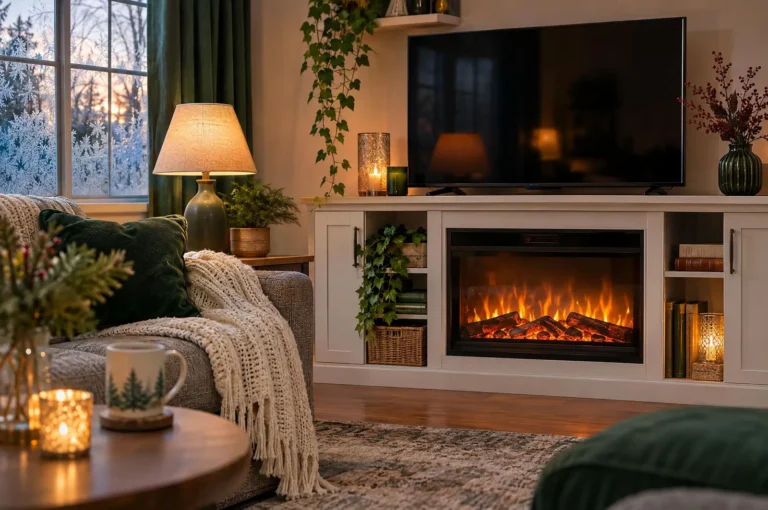
- Recessed gives a cleaner line. With the fireplace flush, the TV and fireplace read as one wall instead of two objects stacked up.
Our guide on whether a fireplace will damage your TV goes deeper on heat and electronics.
Which should you choose?
| Your situation | Our pick | Why |
|---|---|---|
| You rent | Wall-mounted | Comes down with a few patched screw holes |
| Brick, block or concrete wall | Wall-mounted | Cutting masonry is a big job |
| Finishing a basement or building a media wall | Recessed | The framing is happening anyway |
| Exterior wall | Wall-mounted, or recessed into a build-out | Keeps insulation intact |
| TV above, cleanest look | Recessed | Flush line, cord hidden |
| Want it working this weekend | Wall-mounted | No drywall to finish |
| Not sure yet | A dual-mode unit | Hang it now, recess it later |
Browse our wall-mounted and recessed electric fireplaces to compare sizes, or look at the 50-inch Wi-Fi model if you want app and voice control on a unit that does both.
FAQ
Can you put an electric fireplace in the wall?
Yes, if it’s sold as recessed or in-wall. Frame an opening to the maker’s rough-opening size, put an outlet inside it, slide the unit in and finish around it. A wall-mount-only unit shouldn’t be recessed, because it isn’t designed to have its sides and back enclosed.
How much depth does a recessed electric fireplace need?
As much as the unit’s listed depth, plus whatever the manual specifies. A 2×4 wall gives about 3.5 inches and a 2×6 wall about 5.5 inches. If your fireplace is deeper than your cavity, build the wall out.
How do you make an electric fireplace look built in?
Recess it into a framed wall or a build-out, then finish right up to the frame with drywall, tile, stone or wood. A mantel shelf above and a TV centered over it complete the look. Keep every vent and intake clear.
Can you put a TV above an electric fireplace?
Yes. Leave the clearance the manual calls for, know which way the heat blows, and add a mantel shelf if warm air comes out of the top. Keep the TV as low as the clearance allows so you aren’t looking up at it.
How do you trim around an electric fireplace in a wall?
Most recessed units have a front frame that overlaps the drywall edge. Run tile, stone or wood trim up to that frame, not over it, and keep it clear of the air outlet and intakes. Use materials that are fine near a warm surface, and check the manual for any clearance on combustible trim.
Shop the guide
All wall-mounted & recessed electric fireplaces


We write our guides from manufacturer specs and published safety standards, and update them when specs change. Spotted something out of date, or need help with your room? Ask us.